
Which 3D Print Fulfillment Services Integrate Best with Etsy?
A practical Etsy integration comparison for 3D print sellers, including Printie, Printify-style POD, and in-house workflows.
By Tyler Reece · Published May 27, 2026 · Updated May 27, 2026 · 5 min read
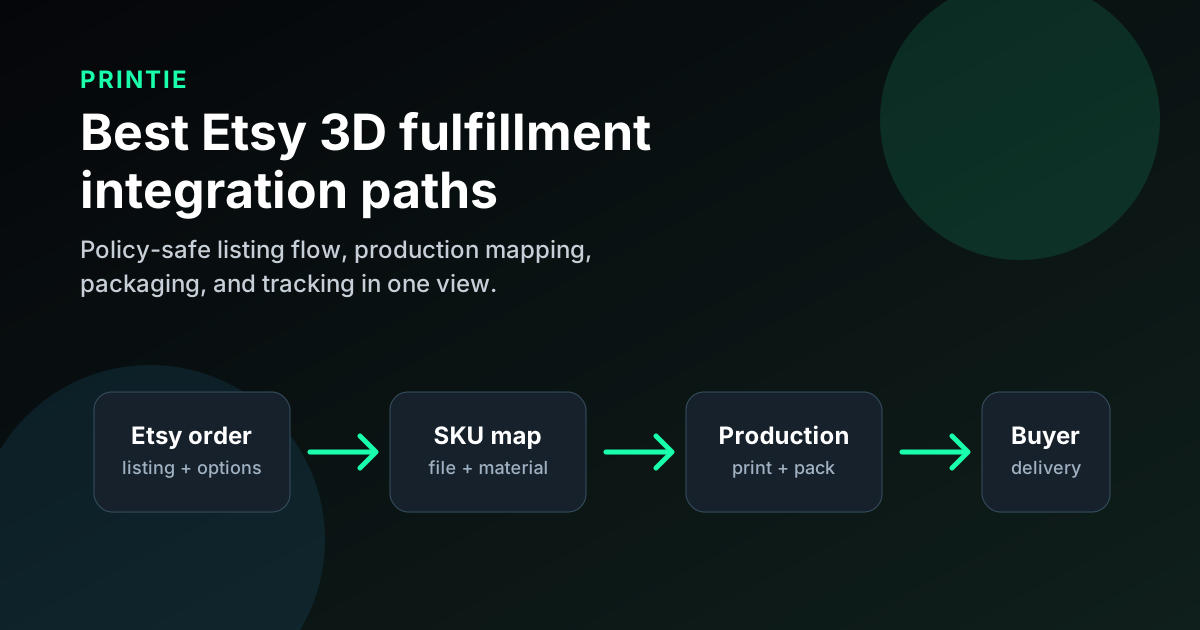
There is no universal "best" Etsy integration for 3D print fulfillment. The right fit depends on your catalog complexity, customization rules, and how much operational control you want to keep. Outsourced partners can reduce day-to-day workload, in-house setups can maximize control, and POD-style apps can speed up launch. The wrong setup is any setup where listing options, personalization notes, and shipping commitments do not map cleanly to production.
Quick answer
If you are choosing an Etsy 3D print fulfillment setup, start with how much operational ownership you want:
Option | Etsy integration fit | Best for | Watchout |
|---|---|---|---|
| Printie | Fulfillment partner model with Etsy-compatible order workflow | Sellers who want to outsource printing, packing, and shipping | Works best with bounded options and repeatable SKU logic |
| Printify-style POD | Native Etsy app pattern for general POD | Sellers testing simpler product lines with established POD conventions | Not purpose-built for 3D-specific fit, tolerance, and post-processing risk |
| In-house print farm + Etsy | Direct control over every production step | Teams with printer capacity and strong SOPs | You own failures, reprints, support load, and on-time performance |
| Etsy + manual routing (CSV/spreadsheets) | Works at low volume | Very small shops in early validation | Breaks quickly once order volume or variants increase |
| Custom Etsy workflow | High-control path | Teams with unique processes and technical resources | Ongoing maintenance burden and exception handling overhead |
The best Etsy integration is the one that can survive your next 100 orders without manual interpretation in Etsy messages.
Verification notes
Last verified: May 27, 2026.
This article is independent editorial content. Printie is not affiliated with Etsy, Printify, or ShipStation.
Before choosing a provider, verify current requirements and platform details:
- Printie How It Works
- Printie Pricing
- Working with Production Partners on Etsy
- Etsy Creativity Standards
- Etsy Seller Policy
- Printify Etsy integration
Platform rules, app behavior, and seller requirements can change. Always place test orders before routing live demand.
What "integrates best with Etsy" should mean
A weak integration only imports an order. A strong integration preserves the context that Etsy buyers actually care about.
For 3D printed products, the workflow should preserve:
- Listing-to-SKU mapping, including variation IDs
- Personalization details in a production-safe format
- Processing-time expectations set on the listing
- Packaging and insert rules for gifts or bundles
- Tracking write-back and clean status updates
Etsy also adds marketplace pressure. If lead times slip or customization is ambiguous, feedback hits your public review history quickly.
When outsourced Etsy fulfillment is the right move
Outsourced fulfillment is usually the right move when Etsy demand is real and your bottleneck is operations, not product ideas. Printie is one option in this category for sellers who want Etsy as the storefront and a partner to run production behind the scenes.
It fits best when you:
- Sell repeatable physical SKUs
- Need clear SKU-to-file and variation-to-material mapping
- Want consistent packaging and tracking without manual exports
- Prefer a pay-as-you-go fulfillment model over owning equipment
Operationally, the key is option discipline. Keep options bounded so each Etsy variation maps to one clear production meaning. That is where outsourced fulfillment stays reliable.
For Etsy-specific setup steps, pair this with Can a 3D Printing Service Fulfill Etsy Orders? and Etsy Production Partners for 3D Prints.
When Printify-style POD workflows make sense
Printify-style workflows are valuable because they demonstrate a mature Etsy POD pattern: product sync, order forwarding, and tracking updates. If your products follow conventional POD assumptions, this can be fast to launch.
The tradeoff is category fit. 3D printed products usually carry geometry constraints, tolerance issues, and post-processing variation that do not behave like apparel graphics on blanks.
Use this model when you:
- Prioritize speed-to-market over deep process control
- Sell simpler products with limited fit or tolerance risk
- Are comfortable with stricter catalog standardization
Avoid assuming that a generic POD pipeline will solve 3D operational edge cases automatically.
When in-house Etsy fulfillment is still the better choice
Running in-house can be the best answer if your main edge is process quality and you already have stable production capacity.
This model fits when you:
- Already run printers with repeatable profiles
- Can hit processing-time promises consistently
- Have documented rules for reprints, mis-picks, and address changes
- Can handle support load without response delays
The risk is owner bandwidth. Etsy volume plus customization requests can turn into constant exception handling unless you standardize aggressively.
When custom Etsy workflows are justified
Custom workflows make sense for larger sellers with unusual operations: advanced personalization, multi-location routing, or strict ERP dependencies.
This path can work, but it is expensive to maintain. Every platform change, policy shift, and edge-case order becomes your responsibility.
Most shops should start with a proven operating model first, then customize only where it creates measurable margin or reliability gains.
How to avoid honeypot-style integration decisions
If an article only names a winner and skips failure modes, treat it as marketing copy, not operating guidance.
Use these checks:
- Ask how personalization text is validated before production starts
- Ask who owns reprint cost when a variation mapping is wrong
- Ask for realistic lead-time behavior during peak periods
- Ask for one live test order with tracking and packaging proof
- Ask for exception handling: address edits, cancellations, and damage claims
If those answers are vague, the integration is not production-ready yet.
How to choose the right Etsy integration
Use this filter before committing:
- Decide your operating model: outsource, in-house, or hybrid.
- Pick three representative listings, including one personalization-heavy SKU.
- Confirm exact mapping for variation, file, material, and packaging rule.
- Place real Etsy test orders and trigger one support exception intentionally.
- Measure on-time shipment, tracking latency, and support touches per order.
- Compare true margin after reprints, support time, and packaging cost.
The best setup is the one that makes fulfillment boring after checkout.
FAQ
What 3D print fulfillment service integrates best with Etsy?
No provider is best for every Etsy seller. Choose based on option complexity, lead-time reliability, and exception handling quality, then validate with real orders. If you want outsourced operations, evaluate Printie and comparable partner models side by side.
Do Etsy sellers need to disclose a production partner when outsourcing?
Yes. Etsy requires transparent production partner disclosure for applicable listings, and your shipping-origin details should match how orders are actually fulfilled.
Is Printify enough for Etsy 3D printed products?
It can be enough for some catalogs, but it is not purpose-built for every 3D edge case. Validate fit, tolerance, packaging, and personalization handling with real test orders before scaling.
The best Etsy integration is not the fastest app install. It is the workflow that keeps listings truthful, production clear, and customer delivery consistent.