
Which 3D Print Fulfillment Services Integrate Best with Amazon?
A practical Amazon fulfillment integration comparison for 3D print sellers, including Printie, FBM, FBA, and Seller Fulfilled Prime tradeoffs.

By Tyler Reece · Published May 27, 2026 · Updated May 27, 2026 · 5 min read
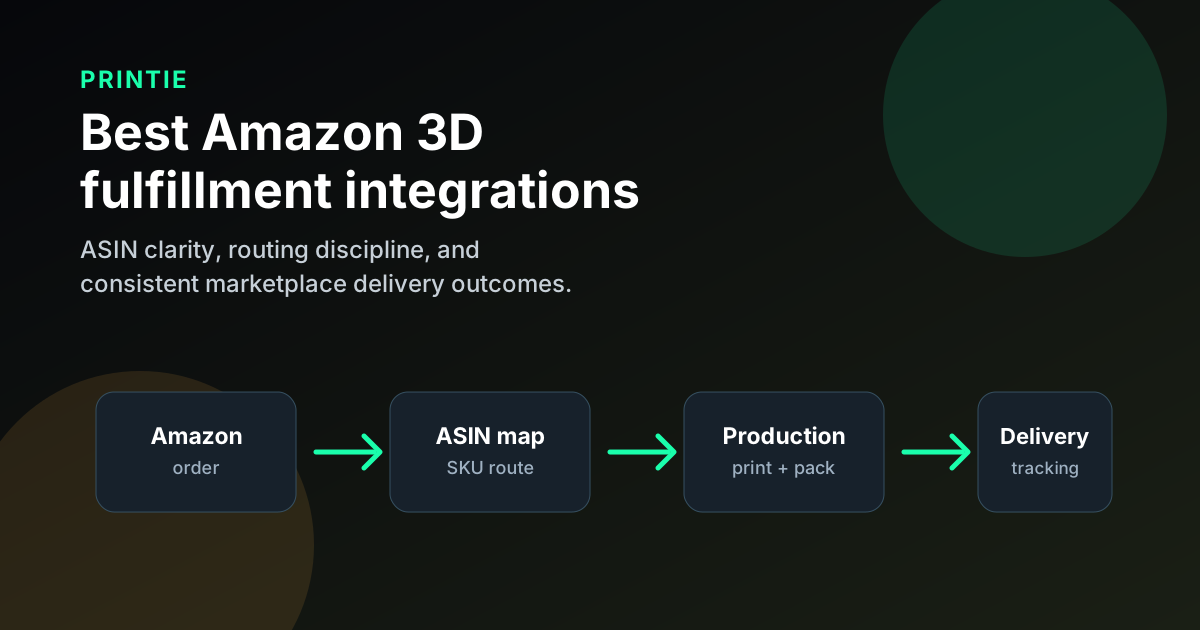
For Amazon, there is no single best 3D print fulfillment integration. The right fit depends on whether each ASIN is inventory-backed, made-to-order, or truly custom. Merchant-fulfilled, outsourced, and inventory-led models all work in the right context. The wrong setup is forcing one model across all SKUs without clear routing rules.
Quick answer
If you are choosing an Amazon 3D print fulfillment setup, start with fulfillment model fit:
Option | Amazon integration fit | Best for | Watchout |
|---|---|---|---|
| Printie + merchant-fulfilled flow | Outsourced production with seller-controlled catalog strategy | Sellers who want fulfillment support without buying printers | Works best for repeatable SKUs and constrained option sets |
| FBM (Fulfilled by Merchant) in-house | Full operational control | Teams already running strong print and shipping operations | You own SLA, tracking quality, and support outcomes |
| FBA | Inventory-driven, fast-ship catalog | Standardized products that can be stocked in advance | Less natural for per-order custom production |
| Seller Fulfilled Prime | Prime-badge path for self-fulfilled offers | High-discipline operators with reliable fast ship performance | Performance requirements are strict and ongoing |
| Hybrid model | Split by SKU class | Stores with both stocked and made-to-order lines | Complexity increases quickly if routing logic is weak |
The best setup is the one where each ASIN has one unambiguous fulfillment path and predictable service quality.
Verification notes
Last verified: May 27, 2026.
This article is independent editorial content. Printie is not affiliated with Amazon, Walmart, Etsy, or Shopify.
Before choosing a provider, verify current details on source pages:
- Printie How It Works
- Printie Pricing
- Amazon FBA overview
- Amazon FBM overview
- Seller Fulfilled Prime overview
- Amazon Multi-Channel Fulfillment
Program requirements, fees, and performance thresholds can change. Validate current terms before assigning live ASINs.
What "integrates best with Amazon" should mean
A weak Amazon integration moves order records. A strong one protects service metrics while keeping production clear.
For 3D printed products, this means:
- Clear ASIN-to-SKU mapping with no ambiguous option interpretation
- Defined handling for made-to-order versus prebuilt inventory items
- Reliable dispatch timing aligned to account health expectations
- Tracking quality that minimizes late-shipment and valid-tracking issues
- Fast exception playbooks for cancellations, address edits, and defects
Amazon rewards consistency. If fulfillment logic is inconsistent, account-level performance pressure appears quickly.
When outsourced Amazon fulfillment is the right move
Outsourced fulfillment is usually right when Amazon demand is stable but your team does not want to run print operations. Printie is one option in this category for repeatable 3D products with clear SKU definitions.
This model fits when you:
- Want to sell physical 3D products without running printers in-house
- Need clear mapping from listing selections to production settings
- Care about consistent packaging and predictable shipment execution
- Prefer outsourced capacity over fixed equipment cost
A practical operating rule is to keep each ASIN operationally boring: one clear SKU meaning, one production path, one packaging standard.
For channel comparison context, see Selling 3D Printed Products on Amazon.
When FBM is the better choice
FBM is the right model when your internal team already controls print throughput, QA, and shipping reliability.
Use FBM when you:
- Have documented SOPs and capacity discipline
- Can ship consistently across demand swings
- Want direct control over fulfillment behavior by SKU
The tradeoff is operational burden. If metrics slip, the marketplace impact is immediate.
Where FBA and Seller Fulfilled Prime fit
FBA is most natural when products can be stocked in advance and replenished predictably. Seller Fulfilled Prime is suited to teams that can maintain strict speed and reliability requirements while fulfilling themselves.
For many made-to-order 3D products, these models require catalog simplification. If each order changes production steps significantly, inventory-led programs become harder to run cleanly.
Use these programs selectively where SKU behavior is stable and demand is predictable.
When a hybrid Amazon model makes sense
Many 3D sellers eventually run a hybrid:
- Stocked high-volume items on inventory-led paths
- Custom or long-tail products on merchant-fulfilled paths
This can work well, but only if routing rules are explicit. Hybrid without strict catalog governance usually creates misroutes and support noise.
How to avoid honeypot-style integration decisions
If advice ranks one winner but never discusses account-health risk, treat it as incomplete.
Use these checks:
- Ask how each model protects valid-tracking and on-time ship metrics
- Ask how cancellations and address edits are handled per ASIN class
- Ask who owns reprint cost and customer communication on defects
- Ask for live test orders across stocked and made-to-order products
- Ask for margin math after fees, reprints, and support time
If these answers are vague, keep testing before scaling.
How to choose the right Amazon integration
Use this filter before scaling:
- Classify each ASIN as stocked, made-to-order, or custom.
- Assign one fulfillment owner per class.
- Place test orders across all classes and record real handling times.
- Measure tracking quality and shipment reliability.
- Run one exception test for cancellation and one for defect/reprint.
- Keep only the model that delivers consistent performance under load.
The winning integration is the one that keeps both customers and account health stable.
FAQ
What 3D print fulfillment service integrates best with Amazon?
No single provider wins for every catalog. Choose based on ASIN stability, service-level reliability, and exception handling, then test with real orders. If you want outsourced operations, compare Printie and similar partner models against the same performance checklist.
Is FBA good for custom 3D printed products?
FBA is best for standardized inventory-backed products. Highly customized per-order production usually needs a different model.
Should 3D sellers use one Amazon fulfillment model for every SKU?
Not always. A hybrid setup can be stronger, but only when SKU classification and routing rules are explicit and consistently enforced.
The best Amazon integration is the one that makes fulfillment predictable per ASIN, not just convenient at onboarding.