
Dropshipping vs Print-on-Demand for 3D Prints on Etsy: What Etsy Might Flag
Etsy allows print-on-demand with a disclosed production partner. Dropshipping is not allowed. Here's the exact difference and what Etsy looks for.
By Tyler Reece · Published May 2, 2026 · Updated May 2, 2026 · 5 min read
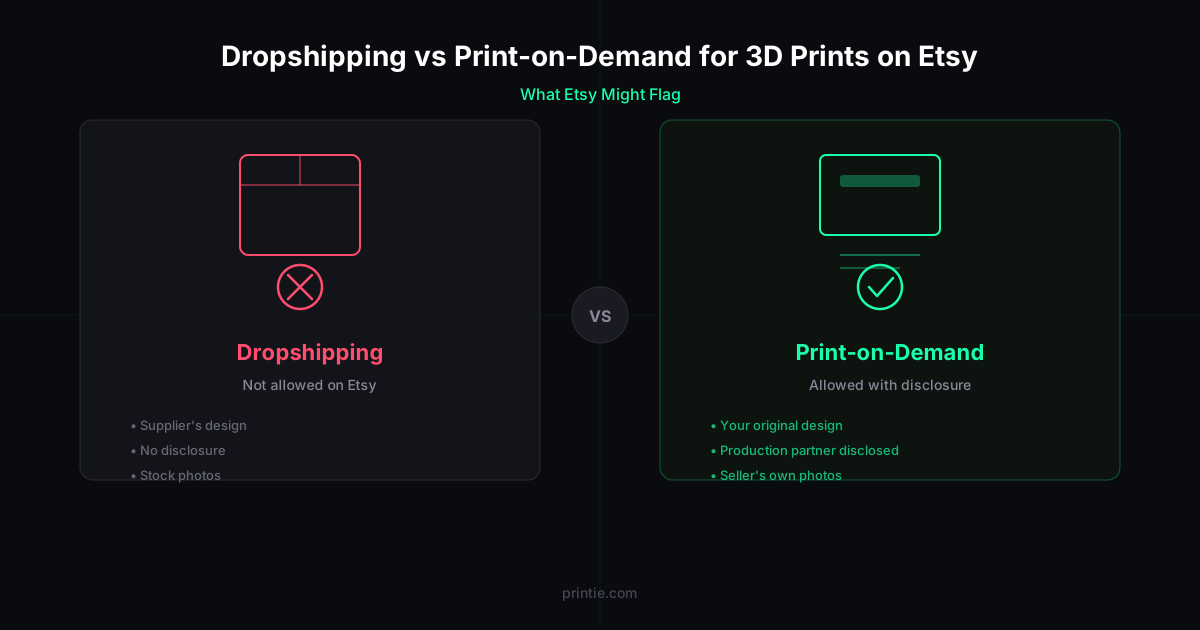
On Etsy, dropshipping and print-on-demand are not treated the same — and the difference determines whether a shop stays compliant. Dropshipping means listing products you did not design, sourced from a manufacturer's catalog. Etsy explicitly disallows that. Print-on-demand — where you designed the product and a disclosed production partner fulfills it — is allowed. For 3D print sellers, the dividing line is design ownership: did you create the file, or are you reselling someone else's inventory? That question shapes everything from listing photos to account risk.
Dropshipping vs print-on-demand: quick comparison
Dropshipping | Print-on-demand (compliant) | |
|---|---|---|
| Who designs the product | Supplier or third party | You (the seller) |
| Who fulfills the order | Supplier ships directly, no disclosure | Disclosed production partner |
| Product photos | Supplier stock images | Seller-created photos or renders |
| Production partner disclosure | N/A — model not permitted | Required in Etsy Shop Manager |
| Etsy policy status | Not allowed | Allowed with proper disclosure |
What Etsy means by "handmade"
Etsy's Creativity Standards define two valid seller roles: maker (you physically produce the item) and designer (you created the design and a disclosed production partner makes it). Both are allowed. What is not allowed is acting as a pure reseller — listing products you did not design, made by a third-party supplier, shipped under your shop name without disclosure.
For 3D printed products, being the designer means owning the original STL or having designed the product for production. If you created the file or co-designed it with a modeler and retain the commercial rights, you qualify as the designer. If you are pulling prints from a supplier's generic catalog and relisting them, that is dropshipping — even if the products look handmade.
What dropshipping looks like on Etsy
In 3D printing, the dropshipping pattern typically appears as:
- Listings sourced from a supplier's catalog you did not design
- Product photos taken directly from the supplier's pages or stock images
- Descriptions that mirror hundreds of other listings with no original framing
- A fulfillment path where the supplier ships to your customer without any disclosure
Etsy detects these patterns through multiple signals: shared listing images, supplier watermarks, pricing that mirrors wholesale catalogs, and shipping origins that do not align with the shop's stated location. The common mistake is assuming that 3D printing automatically counts as "handmade." Etsy evaluates authorship, not manufacturing method. FDM output from PLA is still factory-pattern dropshipping if the seller did not originate the design.
Enforcement can include listing removal, account suspension, or — for repeat violations — permanent closure. Appeals are accepted but not guaranteed.
What print-on-demand looks like on Etsy (the allowed model)
A compliant Etsy print-on-demand workflow has these characteristics:
- The seller designed the product. The STL is the seller's original work or has been licensed for commercial sale under the seller's brand.
- A production partner is disclosed. The partner is listed in Etsy Shop Manager and attached to every relevant listing.
- Listing photos are seller-created. Photos show the actual product — not the fulfillment partner's generic imagery.
- Copy reflects the seller's brand. Descriptions and titles are specific to the seller's shop and products, not copy-pasted from a catalog.
This model puts the seller in the designer role and the fulfillment partner in the production role. Etsy's production partner system was built specifically to accommodate this workflow. The production partner disclosure is not a technicality — it is the mechanism that separates compliant POD from the dropshipping pattern in Etsy's enforcement view.
How to disclose a production partner on Etsy
Production partners must be added in Shop Manager before you can attach them to listings:
- Go to Shop Manager → Settings → Production Partners
- Add the partner's name, country, and a plain-language description of their role
- On each applicable listing, open "About this listing" and select the production partner
- Save the listing — the disclosure appears on the public listing page
If a listing uses a production partner and no disclosure is present, Etsy may treat it as undisclosed outsourcing — which carries the same risk profile as suspected dropshipping. The absence of the disclosure is itself a flag.
For a detailed production partner walkthrough, see Production Partners on Etsy for 3D Prints: How to Disclose Print-on-Demand Fulfillment.
What signals Etsy might flag
Enforcement targets patterns across listings and shops, not just individual items. The highest-risk signals for 3D print sellers:
- Identical images across unrelated shops — if your listing photos match other shops using the same supplier, automated duplication checks will surface them
- Generic product catalog with no design narrative — dozens of unrelated prints with no consistent niche or shop identity reads as reselling
- No production partner disclosure on outsourced listings — required for any production you do not do yourself
- Supplier stock photography — images found elsewhere online, especially from wholesale or manufacturing sites
- Shipping origin mismatch — shop registered in one country, orders consistently shipping from another without explanation
Relisting removed items before an appeal resolves typically escalates enforcement. If enforcement happens, address the root pattern, not just the flagged listing.
How Printie fits
Printie is a production partner, not a dropshipping supplier. You supply the design files and SKU specifications; Printie handles production, quality checks, packaging, and shipping. That keeps you in the designer role Etsy requires and the disclosure requirement is met through the standard production partner process.
For sellers running an Etsy shop, this means the print queue can scale without equipment or headcount while remaining compliant.
Start with How It Works and review Pricing to see how a production partner model fits your Etsy workflow.
Verification notes
Last verified: May 2, 2026.
Printie is not affiliated with Etsy.
Policy language, enforcement patterns, and production partner requirements are subject to change. Before relying on any policy claim in this article, confirm current language directly at:
FAQ
Can I use a 3D print fulfillment service and still sell on Etsy?
Yes — using a production partner to fulfill your orders is allowed when you are the designer of the products and you disclose the production partner in your Etsy shop settings. The key is design ownership and transparent disclosure, not who runs the printer.
What makes Etsy treat a listing as dropshipping vs print-on-demand?
Etsy looks at design authorship, listing transparency, and shop coherence. A listing sourced from a supplier's catalog without design contribution, using stock photos, and without a production partner disclosure fits the dropshipping pattern. A listing based on the seller's original design, with real product photography and an accurate production partner disclosure, is the compliant POD model.
What should I fix first if I'm worried about an Etsy enforcement action?
Prioritize three things in order: confirm all outsourced listings have an accurate production partner disclosure, replace any supplier-sourced images with photos of the actual product, and review the shop catalog for coherence. Random catalog sprawl across unrelated niches raises more flags than a narrow, focused shop with consistent design language.