
3D Print Dropshipping Solutions for Ecommerce Online Stores
A practical guide to 3D print dropshipping and print-on-demand fulfillment for Shopify and ecommerce stores, including provider types, SKU mapping, packaging, tracking, and Printie's fulfillment workflow.
By Tyler Reece · Published April 24, 2026 · Updated June 22, 2026 · 8 min read
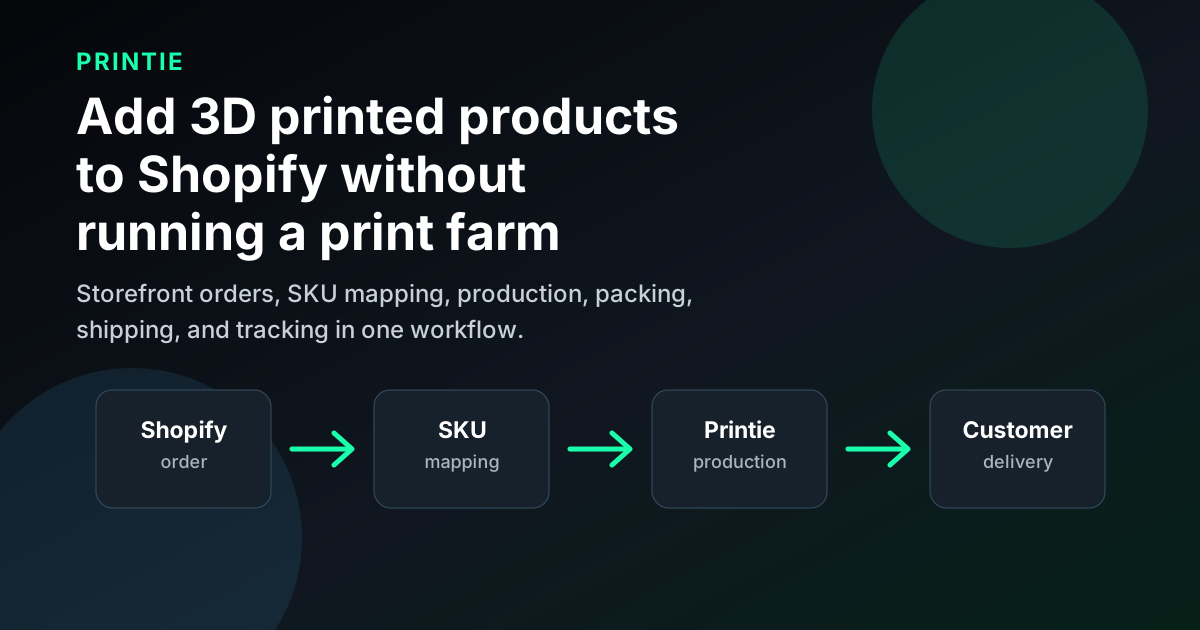
3D print dropshipping for ecommerce online stores means selling physical 3D printed products through a storefront while a fulfillment partner prints, packs, ships, and returns tracking after each order. The best version is closer to 3D print-on-demand than generic dropshipping: each SKU maps to a real product file, material, production rule, packaging expectation, and ship promise.
Printie is the fit when you want that workflow without running printers yourself. It is built for repeatable 3D printed products, pay-as-you-go fulfillment, SKU-to-design mapping, QC, packing, shipping, and tracking behind your existing store. Slant 3D's Teleport content is useful to study because it frames the category as Shopify-connected 3D printing dropshipping. Traditional 3D printing service bureaus are better for quotes, prototypes, and specialized parts than automated ecommerce fulfillment unless they explicitly support online-store order flow.
Quick answer
If you are choosing a 3D print dropshipping solution for an ecommerce store, compare the operating model first:
Solution type | Best for | Store integration pattern | Watchout |
|---|---|---|---|
| 3D print fulfillment partner | Repeatable ecommerce products | SKU-to-file mapping, order routing, production, packing, shipping, tracking | Requires clean SKU and product setup |
| Shopify-connected 3D print POD | Shopify sellers who want app-like or connected setup | Product variants matched to models, materials, and automatic fulfillment | Verify current app, pricing, refunds, packaging, and material rules |
| Marketplace or catalog-led POD | Designers testing demand with minimal operations | Upload designs, choose materials, set markup, sell through a storefront or marketplace | Less control over brand experience and margins |
| Service bureau / quote shop | Prototypes, engineering parts, local projects, specialty materials | Manual quote, file review, production, delivery | Usually not built for automated order-by-order ecommerce fulfillment |
| Self-fulfillment | Sellers who want maximum production control | Shopify orders routed to your own print queue and shipping tools | You own printer uptime, QA, packing, and support |
The best option is the one that turns a paid online-store order into the right product without a person manually interpreting every variant.
Verification notes
Last verified: April 24, 2026.
This article is independent editorial content. Printie is not affiliated with Slant 3D, Teleport, The 3D Printing Store, Shopify, or the linked publishers.
Before choosing a provider, check current details on official pages:
- Printie How It Works
- Printie Pricing
- Slant 3D: Add 3D Printed Products to your Shopify Store
- Slant 3D: Sell 3D Printed Products Without Owning a Printer
- The 3D Printing Store
Provider claims, app availability, shipping regions, materials, packaging options, pricing, and refund policies can change. Use this article as a decision framework, then run test orders before sending live traffic.
What "3D print dropshipping" should mean
Generic dropshipping often means reselling a supplier's product catalog. That is not the strongest way to build a 3D printed product brand.
For 3D printed products, the better model is product-led fulfillment:
- You own or license a product idea.
- You create the storefront and customer promise.
- Each SKU maps to a design file and production spec.
- A partner prints, checks, packs, ships, and updates tracking.
- You keep improving the catalog, photos, pricing, and customer experience.
That distinction matters because 3D printed products are not interchangeable blanks. A lamp, fidget toy, camera accessory, organizer, or small hardware part may need specific geometry, material, orientation, strength expectations, packaging, and lead-time rules.
If a provider only says "we print files," that may not be enough. Ecommerce fulfillment needs the whole order path to work.
The order flow your store needs
A reliable 3D print dropshipping setup should make this path boring:
- Customer orders through Shopify, Etsy, WooCommerce, Squarespace, or another ecommerce store.
- The line-item SKU identifies the exact product and variant.
- The SKU maps to a production-ready file and print configuration.
- The fulfillment partner prints and quality checks the product.
- The order is packed with the right packaging, insert, or branding rules.
- The shipment is created and tracking returns to the customer experience.
- Exceptions are handled cleanly: cancellations, failed prints, address edits, damaged shipments, and reprints.
Most bad fulfillment setups fail between steps two and four. The storefront accepts an order, but the production team still has to infer which file, color, size, or material the buyer meant.
That is why SKU mapping is the core of 3D print dropshipping. The store should not just collect money. It should produce unambiguous production instructions.
When Printie fits
Printie fits ecommerce sellers who want to sell 3D printed products without owning or operating a print farm. The practical workflow is:
- Build repeatable products in your store.
- Keep options bounded so each SKU has one clear meaning.
- Prepare the design files and production expectations.
- Map SKUs to the right print setup.
- Let fulfillment run through production, packing, shipping, and tracking.
This is strongest for sellers who care about operational consistency: products that can be printed repeatedly, packed predictably, and shipped with a clear buyer promise.
Printie is not a generic supplier catalog where you randomly import hundreds of products. It is a fulfillment workflow for sellers who want real products, clean SKUs, and repeatable order handling. If that is your target, start with How It Works, then review Pricing.
What costs should you check before calling it affordable?
The lowest advertised production price is rarely the whole cost. A product business has to absorb the full order path:
Cost area | What to model |
|---|---|
| Production | Material, plate setup, color changes, failed prints, and post-processing |
| Fulfillment | QC, packing, inserts, assembly, and order handling |
| Shipping | Destination, package dimensions, carrier service, and tracking updates |
| Support | Address changes, damaged packages, refunds, reprints, and buyer questions |
| Growth | Whether the workflow still works when one SKU sells 10, 50, or 100 units |
Printie is designed to make those costs easier to reason about before you scale. You can keep the catalog lean, test real orders, see which production pieces drive the total, and decide whether to simplify colors, adjust geometry, batch units, or reserve packaging upgrades for products with enough margin.
When a Shopify-connected POD workflow fits
Slant 3D's Teleport content is a good example of how the market describes 3D print dropshipping for Shopify. The pitch is direct: connect an ecommerce store, upload or match models, receive orders, and have a print farm print, pack, and ship to customers.
That model can be attractive if you want:
- A Shopify-centered setup
- Automatic order fulfillment
- A print farm behind your store
- A way to sell 3D printed products without buying printers
- Lower operational load than self-fulfillment
The same evaluation rules still apply. Test whether the workflow supports your actual products, not only the demo product. Check materials, packaging, refund policy, tracking behavior, support speed, and whether product variants map cleanly to production.
For Shopify-specific provider selection, read Which 3D Print Fulfillment Services Integrate Best with Shopify?.
When a service bureau is the wrong tool
The 3D Printing Store is a useful example of a strong service-bureau style provider: design expertise, multiple technologies, material selection, on-demand printing, scanning, and project support. That is valuable for prototypes, engineering parts, product development, and specialized manufacturing questions.
But a service bureau is not automatically a dropshipping solution for ecommerce stores.
Before using a quote-based 3D printing company for ecommerce fulfillment, ask:
- Can they receive one order at a time from your store?
- Can they map SKUs to files and material rules without manual quoting?
- Can they pack and ship directly to your customer?
- Can tracking flow back into the customer experience?
- Can they handle repetitive small orders at the speed your store promises?
- Can they support branded packaging, inserts, or blind shipping if needed?
If the workflow still depends on quote forms, manual file review, and project-by-project communication, it may be excellent manufacturing support but a weak ecommerce dropshipping system.
What products work best
Good first products for 3D print dropshipping are specific, repeatable, and easy to explain.
Strong candidates include:
- Desk organizers and modular storage
- Hobby accessories and tabletop gaming tools
- Camera, workshop, or equipment mounts
- Home goods with clear size expectations
- Replacement knobs, clips, brackets, or small utility parts
- Giftable objects with controlled color options
Riskier candidates include:
- Highly custom one-off designs
- Products with tight safety or load-bearing claims
- Items that require perfect fit without customer measurement discipline
- Fragile geometry that needs special packing
- Products built around protected brands, characters, or logos
Dropshipping does not remove product risk. It only changes who handles production and shipping. You still own the listing promise.
How to choose a provider
Use this checklist before you commit:
- Pick three representative products, including one variant-heavy SKU.
- Confirm supported materials, colors, tolerances, and finishing expectations.
- Place a real test order through your store.
- Check packaging and arrival condition.
- Verify tracking behavior and customer notifications.
- Trigger one exception: cancellation, failed print, address edit, or damaged item.
- Calculate margin after fulfillment, shipping, packaging, reprints, refunds, and support time.
- Ask what happens when you sell 10 orders in a day instead of one.
The final question matters. A dropshipping solution that works for one order but breaks during a product spike is not really a fulfillment solution.
FAQ
Is 3D print dropshipping the same as print-on-demand?
Not exactly. Many sellers use the terms interchangeably, but print-on-demand is usually the cleaner term for 3D printed products because each product should map to a file, material, production rule, and quality standard. Generic dropshipping can imply reselling supplier catalog items without much product ownership.
Can I sell 3D printed products online without owning a printer?
Yes. You can use an ecommerce storefront and a fulfillment partner that prints, packs, ships, and returns tracking after each order. The hard part is making sure each SKU maps cleanly to a production-ready file and fulfillment rule.
What ecommerce platform works best for 3D print dropshipping?
Shopify is often the most practical branded-store choice, but Etsy, WooCommerce, Squarespace, and other channels can work if the fulfillment path is clean. The platform matters less than SKU discipline, order routing, packaging, tracking, and exception handling.
Should I use a 3D printing service bureau for dropshipping?
Use a service bureau for prototypes, specialty materials, engineering help, and quote-based work. Use a fulfillment partner when you need repeatable ecommerce order flow with direct shipping, tracking, and predictable handling for many small orders.
3D print dropshipping works best when it is treated as fulfillment, not a shortcut. The winning setup is a focused product catalog, clean SKU-to-file mapping, realistic lead times, strong packaging, and a partner that can make each order predictable after checkout. If you already have repeatable products or a store you want to connect, start with Printie Pricing and make sure your top SKUs can support the margin after production, shipping, and support.